Brief history of Lean
Lean is usually told as a Japanese success story. The real history is older, more international and more useful to anyone running a warehouse today.
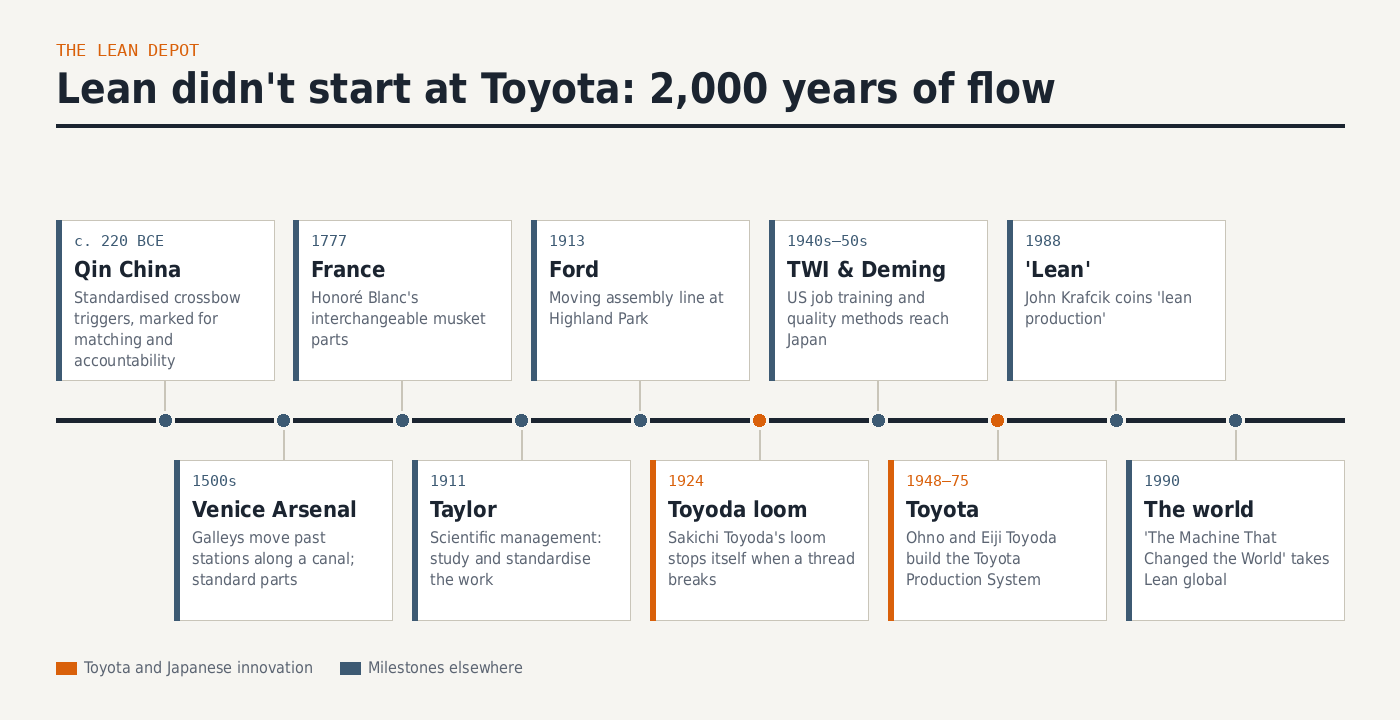
Ask most people where Lean comes from and you'll hear one word: Toyota. That's true, but it's only the last chapter. The ideas at the heart of Lean, such as flow, standard work, building quality in and producing only what's needed, have been rediscovered again and again over two thousand years. Toyota's achievement was to borrow the best of them, add a few of its own, and weave them into one system that worked.
Knowing that history isn't just trivia. It explains why Lean works, why copying the tools rarely does, and what a logistics operation in Asia can take from it today.
How Lean conquered the world
For most of the 20th century, the West saw Japanese manufacturing as cheap imitation. That changed in the 1970s and 1980s.
When the 1973 oil crisis hit, Toyota is widely credited with recovering faster than its rivals, and Japanese industry began studying how it did it. By the 1980s, Japanese cars were winning in the US market on quality and cost, and American manufacturers wanted to know why.
Three moments turned curiosity into a global movement:
- NUMMI (1984). General Motors and Toyota reopened a GM plant in Fremont, California, as a joint venture run on Toyota's system. Largely the same workforce began producing to Toyota's quality standards. It proved the system wasn't about Japanese culture. It was about how the work was organised.
- The word "lean" (1988). John Krafcik, a researcher on MIT's International Motor Vehicle Program, coined "lean production" in his article Triumph of the Lean Production System. Toyota's approach used less of everything: less inventory, less space, less rework, less time.
- The book (1990). The Machine That Changed the World by James Womack, Daniel Jones and Daniel Roos compared car plants around the world and showed the gap in hard numbers. It became a business bestseller. Womack and Jones followed with Lean Thinking in 1996, which turned Toyota's methods into principles any organisation could use.
From there, Lean spread far beyond cars: into hospitals, banks, software, government and, of course, warehouses and logistics.
Older than you think: flow and standards in history
Long before anyone said "Lean", people facing big production problems arrived at the same answers.
Qin China: standard parts and traceable quality
The Terracotta Army, built for China's first emperor around 2,200 years ago, was equipped with real bronze crossbows. Archaeologists studying their trigger mechanisms found them highly standardised in shape. They also found marks on matching parts, used to pair components that fitted together and possibly to identify who made them. Standard parts, organised work cells and accountability for quality: these are ideas we still teach today.
The Venice Arsenal: a moving production line in the 1500s
Venice's state shipyard, the Arsenal, employed around 16,000 people at its peak in the early 1500s. Instead of bringing workers and materials to a ship, Venice moved the ship along a canal past stations that added masts, rigging, weapons and supplies. With standardised parts, it could complete a galley in about a day. That is flow, four centuries before Henry Ford.
Interchangeable parts: France to America
In the 1770s, French gunsmith Honoré Blanc developed muskets made from interchangeable parts, so a broken lock could be swapped instead of hand-fitted. Thomas Jefferson, then the American minister in Paris, took the idea home, and it shaped American arms manufacturing. Interchangeability is what later made both standard work and flow practical at scale.
What Japan learned from the West
The idea that Toyota invented everything is a myth that Toyota's own leaders never claimed. Japan studied Western methods closely, especially after the Second World War.
- Scientific management. Frederick Taylor's Principles of Scientific Management (1911), and the motion studies of Frank and Lillian Gilbreth, taught the world to observe work, measure it and define the best method. Toyota kept the discipline but rejected the idea that only engineers should design the work.
- Ford's flow. Ford's moving assembly line at Highland Park in 1913 showed what continuous flow could do to cost and lead time. When Eiji Toyoda visited Ford in the early 1950s, Ford was producing around 8,000 vehicles a day. Toyota had built about 2,500 in its first 13 years. He came home impressed by the scale, but also convinced that Ford's model carried a lot of waste.
- Quality methods. Walter Shewhart developed statistical process control at Bell Labs in the 1920s. W. Edwards Deming taught these ideas, including the plan-do-check-act cycle, to Japanese managers from 1950. Japan's top quality award, the Deming Prize, was created in his name in 1951.
- Training Within Industry (TWI). A US wartime programme that taught supervisors how to instruct workers, improve methods and handle people problems. It was brought to Japan after the war, and Toyota adopted it in 1951. TWI is one of the roots of standardised work and kaizen.
- The American supermarket. Taiichi Ohno later explained that the supermarket inspired his pull system: customers take what they need, and the shelf is restocked only for what was taken. That is the logic of kanban.
What Toyota added: the Toyota Production System
If Toyota borrowed so much, why did it become the benchmark? Because it faced a problem Ford never had, and it solved it in its own way.
After the war, Toyota was small and short of cash. In 1950 it was close to bankruptcy, and founder Kiichiro Toyoda resigned after a labour dispute. Japan's car market was tiny and wanted many different models in small numbers. Ford's approach of huge volumes, long runs of one model and big buffers of stock simply couldn't work there.
So Toyota built something different, mainly under Taiichi Ohno and Eiji Toyoda between the late 1940s and the 1970s:
- Jidoka: stop at the first problem. In 1924, Sakichi Toyoda, the founder's father, developed an automatic loom that stopped itself when a thread broke. One person could then watch many looms, and defects stopped at the source instead of piling up. Toyota turned this into a principle: stop, fix the cause, and only then continue.
- Just-in-Time. Kiichiro Toyoda's idea of making only what is needed, when it is needed, in the amount needed. Ohno made it work on the shop floor with kanban cards.
- Quick changeovers. Working with Shigeo Shingo, Toyota cut machine changeovers from hours to minutes (later called SMED). Small batches and high variety became affordable.
- Respect for people. Team leaders and operators were expected to spot problems and improve their own work every day. Kaizen became everyone's job, not a project.
- Waste as the enemy. Ohno named the types of waste (overproduction, waiting, transport, over-processing, inventory, motion and defects) and made seeing them a core skill.
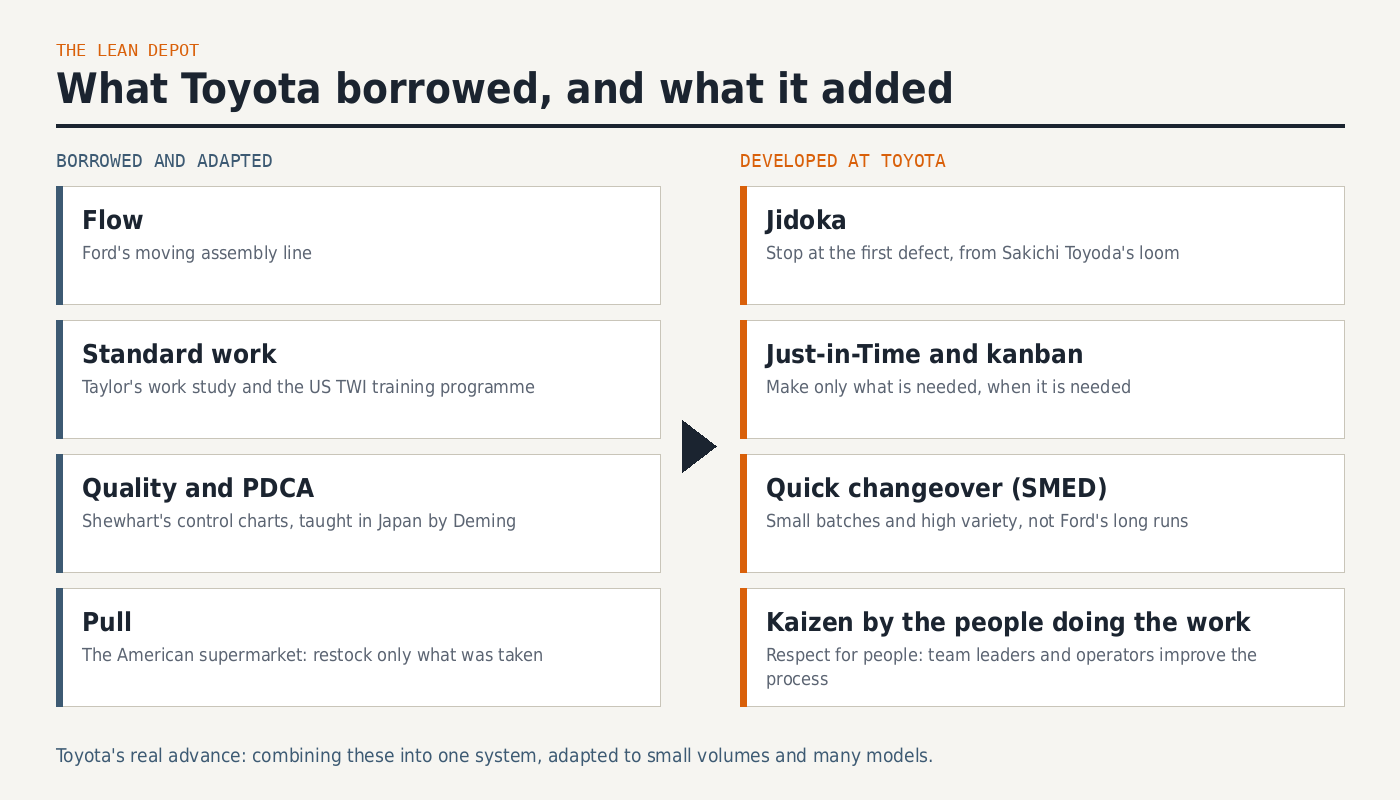
None of these pieces was enough on its own. The breakthrough was the system: each part supports the others. Small batches only work with quick changeovers. Low inventory only works if quality problems are stopped immediately. And none of it lasts without people who improve the process every day. Ohno described it in his book Toyota Production System: Beyond Large-Scale Production (1978).
What this means for warehouses and logistics in Asia
Lean's history carries a lesson for anyone applying it today: borrow the principle, then adapt it to your own conditions. Toyota didn't copy Ford; it adapted flow to a small, high-variety market. Most warehouses in Asia face a similar situation: many SKUs, small orders, fast-changing demand and a mix of manual and automated work.
- Flow: look at how orders move through picking, packing and staging. Large batches waiting between steps are the warehouse version of Ford's buffers.
- Standard work: a clear, simple method for picking, packing and loading, taught the TWI way by showing, explaining and checking, beats a thick SOP nobody reads.
- Jidoka: catch a mis-pick at the pick face with a scan check, not at the customer's receiving dock.
- Pull: replenish pick faces from reserve stock based on what was actually picked, the same logic as Ohno's supermarket.
- People: your pickers and drivers know where the waste is. Give them time and a simple way to fix it.
Future posts on The Lean Depot will take each of these and show how it works in practice.
Key takeaways
- Lean's core ideas of flow, standards, built-in quality and pull are far older than Toyota, from Qin China to the Venice Arsenal.
- Japan learned heavily from the West: Taylor, Ford, Shewhart and Deming, TWI and even the American supermarket.
- Toyota's real innovation was a system adapted to small volumes and high variety, plus jidoka, just-in-time and respect for people.
- Lean went global after NUMMI, the term "lean production" (1988) and The Machine That Changed the World (1990).
- For warehouses today, the lesson is to adapt principles to your own operation rather than copy tools.
Further reading
- Taiichi Ohno, Toyota Production System: Beyond Large-Scale Production
- James Womack, Daniel Jones and Daniel Roos, The Machine That Changed the World
- James Womack and Daniel Jones, Lean Thinking
- John Krafcik, "Triumph of the Lean Production System", Sloan Management Review, 1988
Comments
Post a Comment